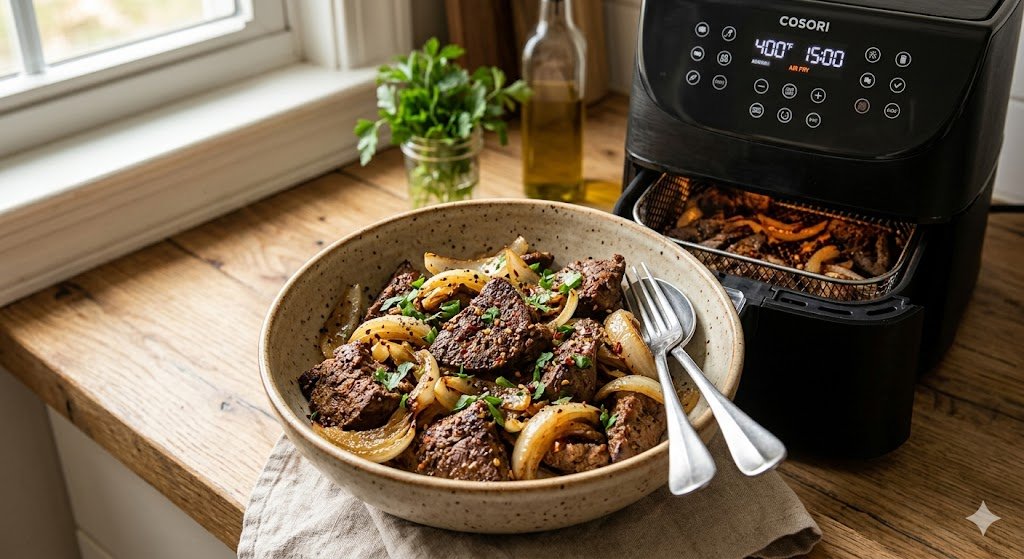
Air-Fryer Beef Liver and Onions
Air-Fryer Beef Liver and Onions: The Crispy, Guilt-Free Classic Your Kitchen Has Been Missing
There is a dish that divides dinner tables. Some folks wrinkle their noses at the mere mention. Others close their eyes and drift back to Sunday afternoons at grandma’s house, where the smell of caramelized onions and rich, earthy meat filled every corner of the room. Beef liver and onions is that dish. It carries baggage. It carries nostalgia. And if you have been avoiding it because of a rubbery, gray childhood trauma served on a chipped plate, you are about to have your mind changed.
The air fryer is not just another kitchen gadget collecting dust on your counter. It is a time machine. It takes the recipes your ancestors sweated over for hours and hands them back to you—crisper, faster, and without the sink full of greasy pans. Air-fryer beef liver and onions is not a compromise. It is an upgrade.
Why Your Body Is Begging for This Dish
Let us cut through the noise. Beef liver is not trendy. It will never grace the menu of a hip downtown bistro with Edison bulbs and twenty-dollar toast. But here is what it will do: it will flood your system with nutrients that most modern diets barely touch.
A single serving of beef liver delivers more vitamin A than you need in a week. It packs vitamin B12 in amounts that make supplements look like a joke. Iron, folate, zinc, and high-quality protein come standard. This is not health food in the sad, flavorless sense. This is food that actually feeds you.
Table
| Nutrient | What You Get (per 3.5 oz) | Why It Matters |
|---|---|---|
| Protein | 20.4 grams | Muscle repair, lasting fullness |
| Vitamin A | 16,899 IU | Vision, immune defense, skin health |
| Vitamin B12 | 59.3 mcg | Energy, brain function, nerve health |
| Iron | 6.5 mg | Oxygen transport, fighting fatigue |
| Folate | 290 mcg | Cell growth, heart health |
| Calories | 135 | Nutrient density without the bloat |
The problem has never been the liver itself. The problem has been the cooking method. Pan-frying in half a stick of butter turns a nutritional powerhouse into a greasy gut bomb. Boiling it into gray submission destroys every reason to eat it in the first place. The air fryer fixes both issues. You use a fraction of the oil. You control the heat with precision. You walk away with crispy edges, a tender center, and a plate that does not require a nap afterward.
Picking Liver That Does Not Fight Back
Your recipe is only as good as what you put into it. Walk into any decent butcher shop and you will find beef liver sitting there, dark and glistening, often overlooked by shoppers chasing ribeyes. That is your opportunity.
Look for deep reddish-brown color. Pale or gray patches signal age or poor handling. The surface should feel firm and slightly moist, never slimy. If you can source grass-fed, pasture-raised liver, grab it. The omega-3 profile is superior, and the flavor is noticeably cleaner.
Here is the step most home cooks skip—and it costs them: the soak. Submerge your liver in milk for thirty to sixty minutes before cooking. Whole milk works best, but buttermilk is even better if you have it. This is not some old wives’ tale. The lactic acid tames the metallic edge that puts people off liver forever. It draws out residual blood. It leaves you with a mild, almost sweet base that takes seasoning beautifully.
After soaking, pat the slices bone-dry with paper towels. Water is the enemy of crispiness. Trim away any tough membrane or connective tissue. Slice into quarter-inch strips, uniform in thickness so nothing overcooks while you wait for the rest to catch up.
The Recipe That Converts Skeptics
You do not need a culinary degree. You need twelve minutes and a working air fryer.
What Goes In
Table
| Ingredient | Amount | Notes |
|---|---|---|
| Beef liver, sliced | 1 pound | Soaked, dried, membrane trimmed |
| Yellow onions | 2 large | Sliced into thick rings |
| Olive oil | 2 tablespoons | Divided |
| Garlic powder | 1 teaspoon | Or 2 cloves fresh, minced fine |
| Smoked paprika | 1 teaspoon | Adds depth without heat |
| Salt | 1 teaspoon | Kosher or sea salt |
| Black pepper | ½ teaspoon | Freshly cracked |
| Worcestershire sauce | 1 tablespoon | Optional but recommended |
| Fresh parsley | 2 tablespoons | Chopped, for finishing |
How to Build It
-
Fire up your air fryer to 375°F. Let it run empty for three minutes. A hot start means immediate sear, not slow steam.
-
Toss your onions with half the oil, a pinch of salt, and some pepper. Spread them in the basket and cook for eight minutes, shaking once at the four-minute mark. You want soft centers with charred edges. Pull them out and set aside.
-
Season your liver strips. Drizzle the remaining oil. Add garlic powder, paprika, salt, pepper, and Worcestershire if you are using it. Massage everything in evenly.
-
Lay the liver in a single layer. Overlap is not allowed here. Crowding traps moisture. Moisture kills crisp. If your air fryer is small, work in batches. Patience pays.
-
Cook six minutes on the first side. Flip each piece. Go another four to five minutes. You are aiming for 155°F internal temperature. A cheap meat thermometer removes all guesswork.
-
Reunite liver and onions. Throw the onions back in for the final two minutes. They reheat, caramelize further, and soak up the meat juices.
-
Rest for three minutes. This is non-negotiable. The fibers relax. The juices settle. The texture transforms from good to unforgettable.
-
Scatter parsley over the top. Serve immediately.
What to Pile on the Plate Beside It
Liver is rich. It demands balance. Mashed potatoes are the classic move for a reason—the creaminess cuts through the intensity. If you want to keep things lighter, roasted sweet potatoes do the same job with extra fiber and color.
A pile of sautéed spinach or kale doubles down on the iron content and adds freshness. Crusty sourdough is not just for show; it is your tool for chasing every bit of onion and juice across the plate. And if you are the type who plans meals around wine, reach for something bold. A Cabernet Sauvignon or Malbec stands up to the depth of flavor without disappearing.
The Mistakes That Ruin Everything (And How to Dodge Them)
Even a simple recipe has traps. Here are the ones that catch people most often.
Table
| The Mistake | Why It Destroys Your Dinner | The Fix |
|---|---|---|
| Skipping the milk soak | Bitter, metallic aftertaste that lingers | Thirty minutes minimum. Set a timer. |
| Wet liver going into the basket | Steamed, gray, sad results | Pat with paper towels until they come away dry |
| Overcrowding the air fryer | Everything boils in its own juice | Single layer. Batches exist for a reason. |
| Cooking past 160°F | Rubber. Pure rubber. | Thermometer. Pull at 155°F. Trust carryover. |
| Straight from fridge to fryer | Cold center, burnt exterior | Fifteen minutes on the counter first |
Keeping the Good Stuff for Later
Leftovers happen. Maybe you got ambitious with the pound of liver. Maybe your eyes were bigger than your stomach. Either way, storage is straightforward.
Refrigerate in an airtight container for up to three days. Freeze tightly wrapped for two months, though the texture softens slightly upon thawing. When you reheat, go back to the air fryer at 350°F for three or four minutes. It revives the crispness in a way no microwave ever could. Speaking of microwaves—avoid them. Unless you enjoy chewing on a tire, use the air fryer or a hot skillet.
Frequently Asked Questions
Does air-fryer beef liver and onions taste less intense than the pan-fried version?
Yes, and it is not your imagination. The rapid, dry heat of the air fryer reduces the strong odor that clings to walls for hours. Combined with the milk soak, this method produces the mildest liver you have ever tasted.
How long does beef liver actually take in the air fryer?
At 375°F, sliced liver needs roughly ten to twelve minutes total. Six minutes on the first side, flip, then four to five more. Always verify with a thermometer.
Can I skip the milk soak if I am in a hurry?
You can, but you will pay for it in flavor. If time is tight, even a fifteen-minute soak in salted water helps. But for the full transformation, give it the full hour.
Is slightly pink liver safe to eat?
Absolutely. Unlike poultry, beef liver is safe and actually ideal at medium doneness. Slightly pink in the center means tenderness. Gray all the way through means you went too far.
Why does my air fryer smoke when I cook liver?
Excess fat dripping onto the hot heating element is the culprit. Trim the edges of your liver slices before cooking. Adding a tablespoon of water to the drawer below the basket also catches drips without creating a smoke show.
Your Turn to Cook
You have the knowledge. You have the steps. You have the ingredient list sitting in front of you. The only thing left is to stop reading and start cooking.
Air-fryer beef liver and onions is not about perfection. It is about rediscovering a food that your grandparents ate for strength, your parents maybe abandoned for convenience, and that you now have the tools to make better than either generation managed. The air fryer does the hard work. You reap the crispy, nutrient-dense reward.
So preheat that basket. Slice those onions. Soak that liver. And when you pull your first batch out—golden-edged, fragrant, and somehow both nostalgic and brand new—take a photo. Drop a comment below. Tell us who you converted. Because everyone has a liver skeptic in their life, and this recipe is your secret weapon.
Your kitchen is waiting. Your body is waiting. Go cook something worth remembering.